
Armenian Food Words and How to Order in Yerevan
The Armenian food words you will actually use in Yerevan: classic dishes like khorovats, tolma and gata, everyday ingredients and drinks, and simple phrases for ordering at a restaurant.

The Armenian food words you will actually use in Yerevan: classic dishes like khorovats, tolma and gata, everyday ingredients and drinks, and simple phrases for ordering at a restaurant.
Learn Armenian family words, from mother and father to grandparents, aunts, uncles and in-laws, plus how to say my mother and ask about someone's family.
A clear guide to the Armenian present tense: how to build the -um form, the six forms of the auxiliary, how to make negatives and questions, and the mistakes learners make most.
The 25 most common Armenian verbs for beginners, with simple example sentences, a quick guide to -el and -al infinitives, and how to use them in the present tense.
Learn the days of the week in Armenian, the twelve months, how to say the date, and a handful of phrases you will use every week when making plans.

A realistic look at how long it takes to learn Armenian, level by level, with rough hour estimates and the habits that make the biggest difference to your progress.
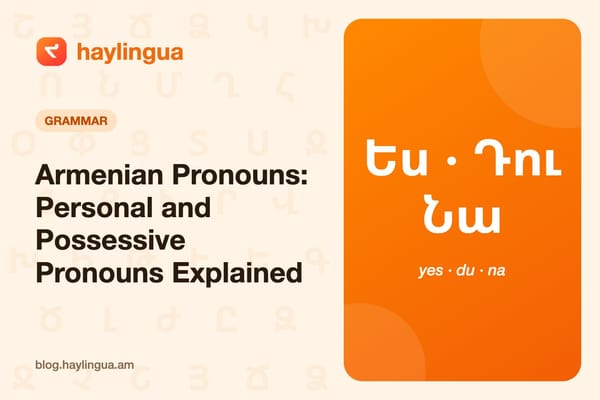
A clear guide to Armenian pronouns: yes, du, na, menk, duk and nrank, when to use the polite duk, object forms like indz and kez, and possessives like im, ko and the endings -s and -d.
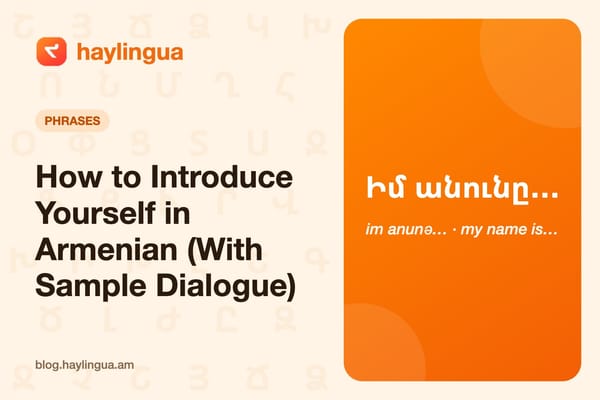
Learn how to introduce yourself in Armenian: your name, where you're from, what you do, your age and languages, with polite and informal forms and a short sample dialogue.
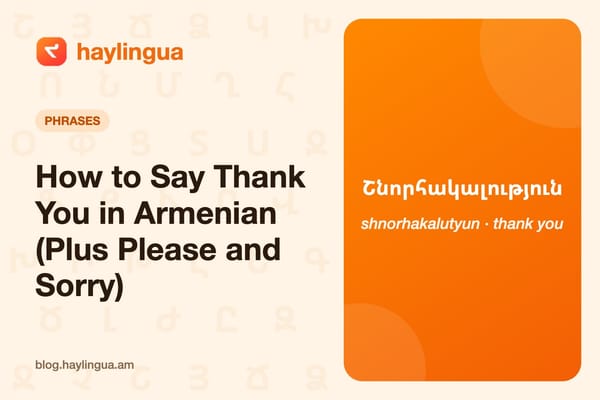
How to say thank you in Armenian, from shnorhakalutyun to the casual mersi, plus how to say please, you're welcome and sorry, with a short café dialogue.
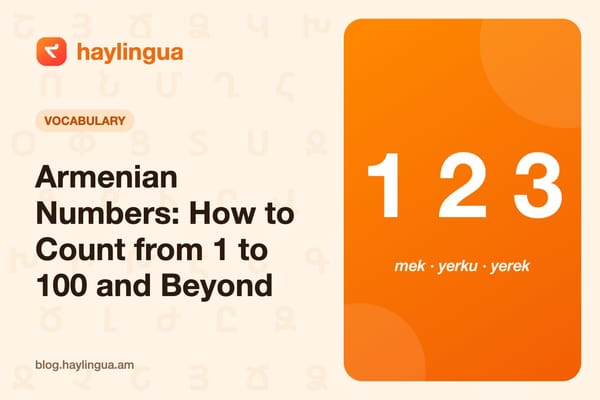
Learn Armenian numbers from zero to a hundred and beyond, see how compound numbers and ordinals are built, and pick up useful phrases for prices, age and dates.
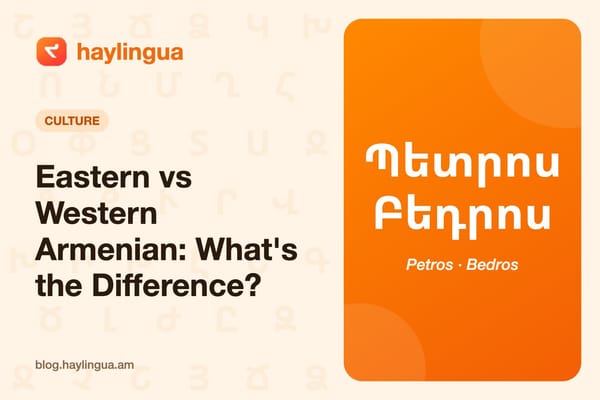
Eastern vs Western Armenian explained in plain terms: where the split came from, who speaks which, how pronunciation, spelling and grammar differ, and which one to learn first.

Is Armenian hard to learn? Some parts are, like the new alphabet, a few unfamiliar sounds and the case endings. Other parts are easier than most people expect. Here is an honest look at both.
Learn Armenian
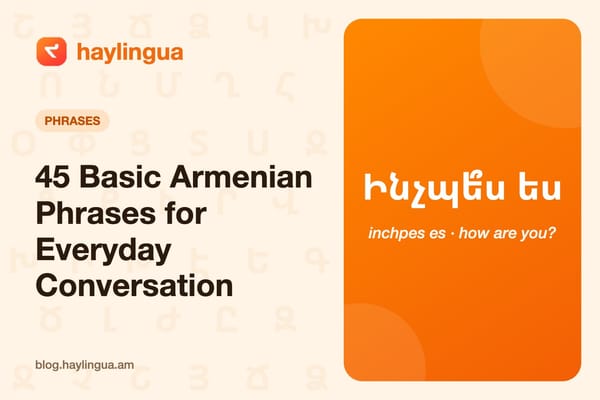
45 basic Armenian phrases grouped by situation: greetings, small talk, introductions, understanding, politeness, shopping and eating out, and getting around, with pronunciation for each.
Learn Armenian
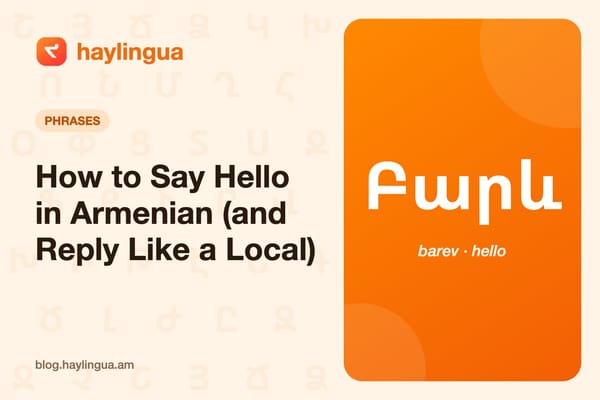
Barev is the everyday way to say hello in Armenian, but there is more to it. Learn polite and casual greetings, good morning and good evening, how to ask how someone is, and how to say goodbye.
Learn Armenian
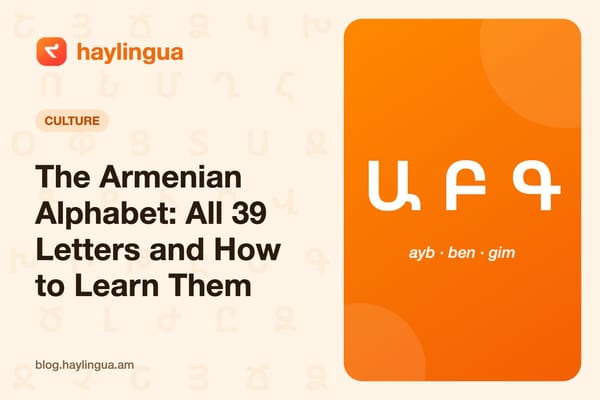
The Armenian alphabet was created by Mesrop Mashtots in 405 AD. Here are all 39 letters of the modern Eastern Armenian alphabet with their sounds, a little history and practical tips for learning them.
Learn Armenian
Want to learn Armenian but not sure where to begin? Here is a realistic order for beginners: the alphabet, a small set of everyday phrases, core grammar, a daily habit and speaking early.
News
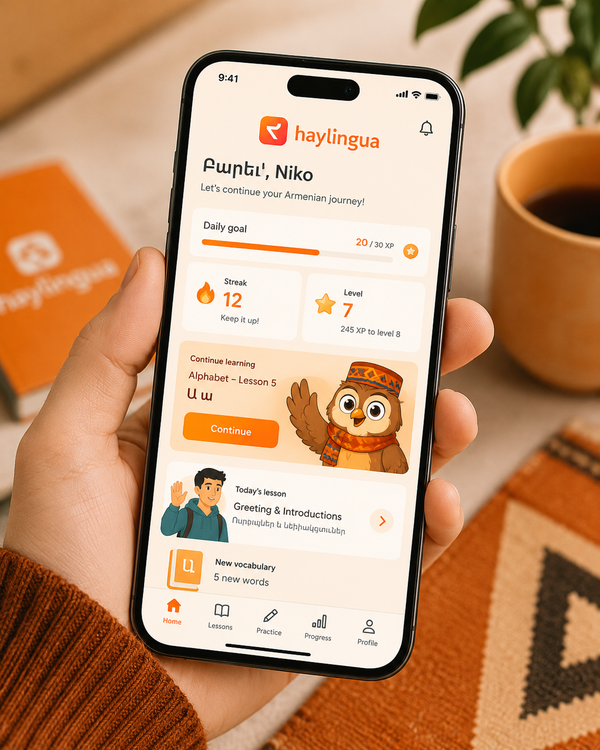
Learning Armenian is about to become even easier. We are excited to announce that the Haylingua mobile app is coming soon, bringing your Armenian lessons, progress and daily learning routine directly to your phone. Whether you are learning your first Armenian letter, improving your pronunciation or preparing to speak with
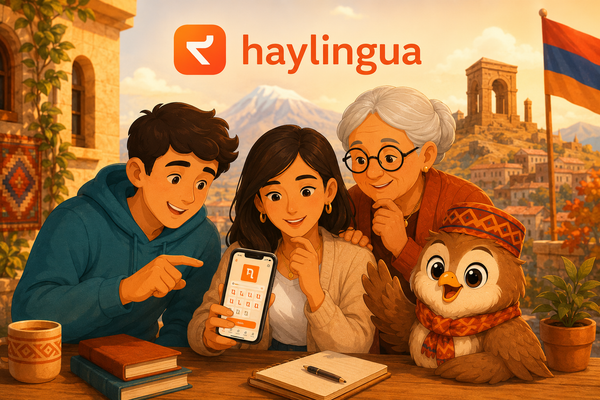
For many people, learning Armenian is not only about vocabulary, grammar or pronunciation. It is about understanding family conversations, connecting with relatives, exploring Armenian culture and feeling closer to a part of your identity that may have always seemed slightly out of reach. At Haylingua, we believe that learning Armenian
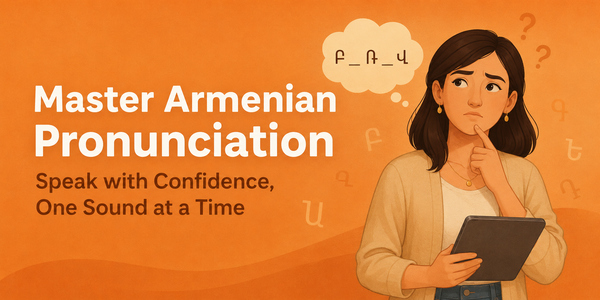
Learning Armenian can feel exciting at first. You begin with familiar words such as barev, shnorhakalutyun, and inchpes es. But as soon as you start speaking in full sentences, pronunciation can become one of the biggest challenges. The good news is that Armenian pronunciation becomes much easier when you practise

Learning Armenian does not have to mean sitting at a desk for hours. In fact, the easiest way to improve is to make the language part of your normal routine. A few minutes of regular practice can help Armenian feel more familiar, natural and useful over time. Here are seven

Learning a new language is always an investment — but learning Armenian is something different entirely. It's a doorway into one of the world's oldest living civilizations, a culture that has survived empires, diaspora, and centuries of transformation while keeping its language, traditions, and identity fiercely intact.

Learning a new language often feels like climbing a mountain without a map. If you’ve ever tried to tackle the Armenian alphabet or complex grammar on your own, you know the struggle. That is exactly why Haylingua was created—to turn that mountain into a series of fun, manageable

In a world increasingly dominated by a handful of global languages, why should anyone turn their attention to Armenian? It is easy to look at Armenian as a "historical" language—the tongue of the first Christian nation, a 3,000-year-old Indo-European isolate, and a survivor