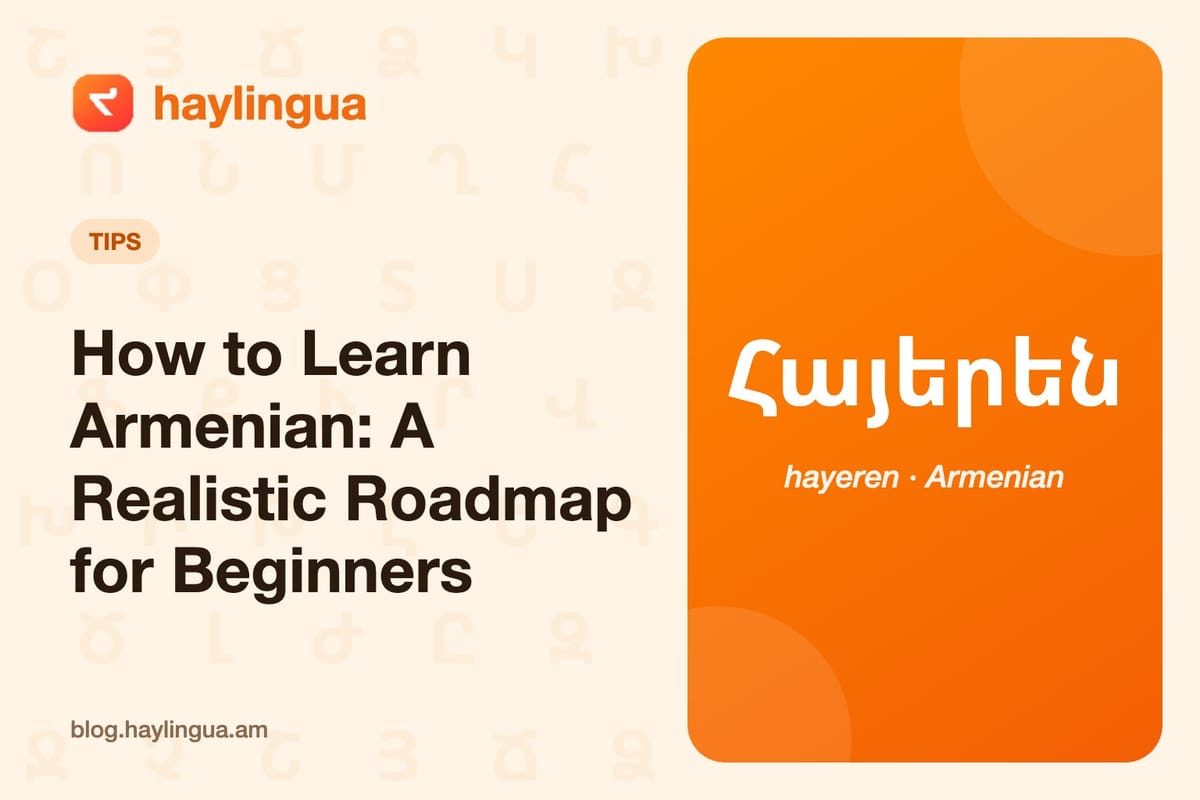
How to Learn Armenian: A Realistic Roadmap for Beginners
Want to learn Armenian but not sure where to begin? Here is a realistic order for beginners: the alphabet, a small set of everyday phrases, core grammar, a daily habit and speaking early.

If you want to learn Armenian, the hardest part is often knowing where to start. There are far fewer textbooks than for Spanish or French, and a lot of advice online mixes Eastern and Western Armenian without saying so. This roadmap is for beginners learning Eastern Armenian, the standard language of Armenia. It follows the order that works for most learners, and it is honest about how long each step takes.
Step 1: Learn the alphabet first
It is tempting to skip the Armenian script and rely on transliteration. Please don't. There is no single standard for writing Armenian in Latin letters, so the same word can be spelled three different ways, and you will get stuck the moment you see a street sign or a menu.
The alphabet has 39 letters and is very phonetic: once you know a letter, you know how it sounds, with only a few exceptions. Most people can read slowly after two or three weeks of short daily practice. Learn a handful of letters at a time and start reading real words straight away, even if they are just place names like Երևան (Yerevan) and Հայաստան (Hayastan) – Armenia.
Step 2: Get a small set of phrases you can use every day
Alongside the alphabet, learn around a dozen phrases you will actually say. They give you something real to practise with and build confidence early. A good starting set:
- Բարև (barev) – hello
- Ինչպե՞ս ես (inchpes es) – how are you? (informal)
- Լավ եմ (lav em) – I'm fine
- Շնորհակալություն (shnorhakalutyun) – thank you
- Խնդրում եմ (khndrum em) – please; you're welcome
- Ներողություն (neroghutyun) – sorry; excuse me
- Այո (ayo) – yes
- Ոչ (voch) – no
- Ես չեմ հասկանում (yes chem haskanum) – I don't understand
- Ես հայերեն եմ սովորում (yes hayeren em sovorum) – I'm learning Armenian
- Ցտեսություն (tstesutyun) – goodbye
The last-but-one phrase is worth memorising. People in Armenia are usually delighted when a foreigner or a diaspora Armenian makes the effort, and saying it tends to make them slow down and help you.
Step 3: Grammar basics, in a sensible order
Armenian grammar has a reputation for being tough, but the beginning is friendlier than people expect. There is no grammatical gender, so you never have to remember whether a table is masculine or feminine. The word նա (na) means both he and she.
Here is a good order for the first few months:
- Personal pronouns and the verb "to be". Ես ուսանող եմ (yes usanogh em) – I am a student.
- The present tense. Most verbs end in -ել (-el) or -ալ (-al), and the present is built in a regular way: գրել (grel) – to write becomes ես գրում եմ (yes grum em) – I write, I am writing.
- Plurals. Words of one syllable usually take -եր (-er) and longer words take -ներ (-ner): դաս (das) – lesson, դասեր (daser) – lessons; քաղաք (kaghak) – city, քաղաքներ (kaghakner) – cities.
- The definite article. Armenian puts "the" at the end of the word, as -ը or -ն, rather than in front of it.
- A few cases. Start with the ones you need in daily life, such as "in" and "from": Երևանում (Yerevanum) – in Yerevan, Երևանից (Yerevanits) – from Yerevan.
You do not need to master the whole case system before you start talking. Learn the endings as they come up in real sentences, and the patterns will slowly start to feel normal.
Step 4: Build a daily habit you can keep
Consistency beats intensity. Twenty minutes every day will take you further than a three-hour session once a week, because language learning is mostly memory, and memory needs repetition.
- Review vocabulary with spaced repetition, so words come back just before you would forget them.
- Read something short in Armenian every day, even a single sentence.
- Listen to Armenian while you do something else: music, a podcast, a video with subtitles.
- Keep a small notebook of phrases you have heard and want to use.
Tie your practice to something you already do, like your morning coffee or your commute. A habit attached to an existing routine is much harder to skip.
Step 5: Start speaking earlier than feels comfortable
Many learners wait until they "know enough" before they speak. That moment never really arrives. Start using what you have in the first month, even if it is only greetings and numbers.
If you live in Armenia, treat shops, taxis and cafés as free practice. Say hello in Armenian, ask the price, say thank you. If you are abroad, look for a tutor, a conversation partner or a patient relative. Many diaspora learners understand far more than they can say, and speaking is the only thing that closes that gap.
Expect to make mistakes with endings and word order. Nobody minds. What people remember is that you tried.
How long it takes to learn Armenian
With steady daily practice, most beginners can read the alphabet within a few weeks, manage simple everyday situations within a few months, and hold basic conversations by the end of their first year. Your pace depends on how much time you put in, whether you hear Armenian around you, and whether you already speak a language with cases, such as Russian.
The main thing is to learn Armenian in a clear order rather than jumping between random apps and word lists. Alphabet, phrases, core grammar, a daily habit, speaking.
If you would like a structured path that follows this order, Haylingua has Eastern Armenian courses that start with the very first letter and go all the way up to C1.