Is Armenian Hard to Learn? An Honest Answer
Is Armenian hard to learn? Some parts are, like the new alphabet, a few unfamiliar sounds and the case endings. Other parts are easier than most people expect. Here is an honest look at both.

Is Armenian hard to learn? It is one of the first things people ask us, and the honest answer is: it takes real effort, but less than its reputation suggests. Armenian has its own alphabet, some sounds English doesn't have, and a system of case endings. It also has regular spelling, no grammatical gender and surprisingly regular verbs. Here is a clear look at both sides, so you know what you are signing up for.
Is Armenian hard to learn? The short answer
For an English speaker, Armenian is harder than Spanish or Italian and easier than it looks at first glance. Armenian is an Indo-European language, so it is a distant relative of English, but it sits on its own branch of the family tree, with no close relatives. That means fewer shortcuts. It does not mean it is impossible. People who study steadily a little each day usually handle everyday conversations within their first year.
What is genuinely hard
A new alphabet
The Armenian alphabet has 39 letters, and none of them look quite like the Latin letters you already know. For the first week or two, reading feels slow and tiring. This is the part that puts most people off, and it is also the part that passes quickest. Most learners can read, slowly, within a few weeks.
Some unfamiliar sounds
Armenian has a few sounds that take practice: խ (kh), like the ch in Scottish "loch", and ղ (gh), a soft sound from the back of the throat. It has two kinds of r, a rolled ռ and a softer ր. The biggest challenge is the difference between aspirated and unaspirated consonants. կար (kar) – there was and քար (kar) – stone sound almost the same to an English ear, but not to an Armenian one.
Noun cases
Eastern Armenian has seven cases, which means nouns change their endings depending on their role in the sentence. English speakers usually find this the hardest part of the grammar. Here is how one word changes:
- քաղաք (kaghak) – city
- քաղաքի (kaghaki) – of the city
- քաղաքին (kaghakin) – to the city
- քաղաքից (kaghakits) – from the city
- քաղաքով (kaghakov) – through or by the city
- քաղաքում (kaghakum) – in the city
The good news is in that list, though. The endings simply attach to the word, and they stay the same for most nouns. In the plural, you add the plural ending first and then the same case ending: քաղաքներից (kaghaknerits) – from the cities. Compared with languages where every noun type has its own set of endings, this is quite tidy.
Formal and spoken Armenian
Textbook Armenian and the Armenian you hear on the streets of Yerevan are not quite the same. People shorten words, use Russian loanwords and speak fast. A textbook teaches Ինչպե՞ս ես (inchpes es) – how are you?, while friends will often say Ո՞նց ես (vonts es). You need both, and learning the spoken forms takes time and exposure.
Fewer resources
There are simply fewer courses, books and podcasts for Armenian than for major European languages. Many online materials also mix Eastern and Western Armenian without saying which is which, and that can confuse beginners. Make sure your materials match the variety you want to learn.
What is easier than you expect
- Spelling is phonetic. Once you know the letters, you can read almost any word aloud correctly, even one you have never seen. After English spelling, this feels like a gift.
- No grammatical gender. There is no masculine or feminine to memorise. Even "he" and "she" are the same word: նա (na).
- Regular verbs. Most verbs belong to one of two groups, ending in -ել (-el) or -ալ (-al), and follow clear patterns. The present tense is especially simple: ես գրում եմ (yes grum em) – I write, դու գրում ես (du grum es) – you write.
- Simple articles. "A" is մի (mi) before the noun, as in մի գիրք (mi girk) – a book. "The" is an ending, -ը or -ն, attached to the word.
- Flexible word order. Because the endings show who does what, small mistakes in word order rarely stop people understanding you.
- Some familiar roots. As a distant cousin of English, Armenian shares a few old roots: մայր (mayr) – mother, եղբայր (yeghbayr) – brother, անուն (anun) – name, նոր (nor) – new.
- Patient native speakers. Armenians are usually thrilled to hear a foreigner speak even a few words, and very forgiving of mistakes.
What makes the difference
How hard Armenian feels depends a lot on your starting point. Speakers of Russian or another language with cases find the grammar more familiar. Diaspora Armenians who heard the language at home often have good pronunciation and a big passive vocabulary, even if they struggle to speak. People who live in Armenia, including international students in Yerevan, get daily practice just by buying bread or taking a taxi.
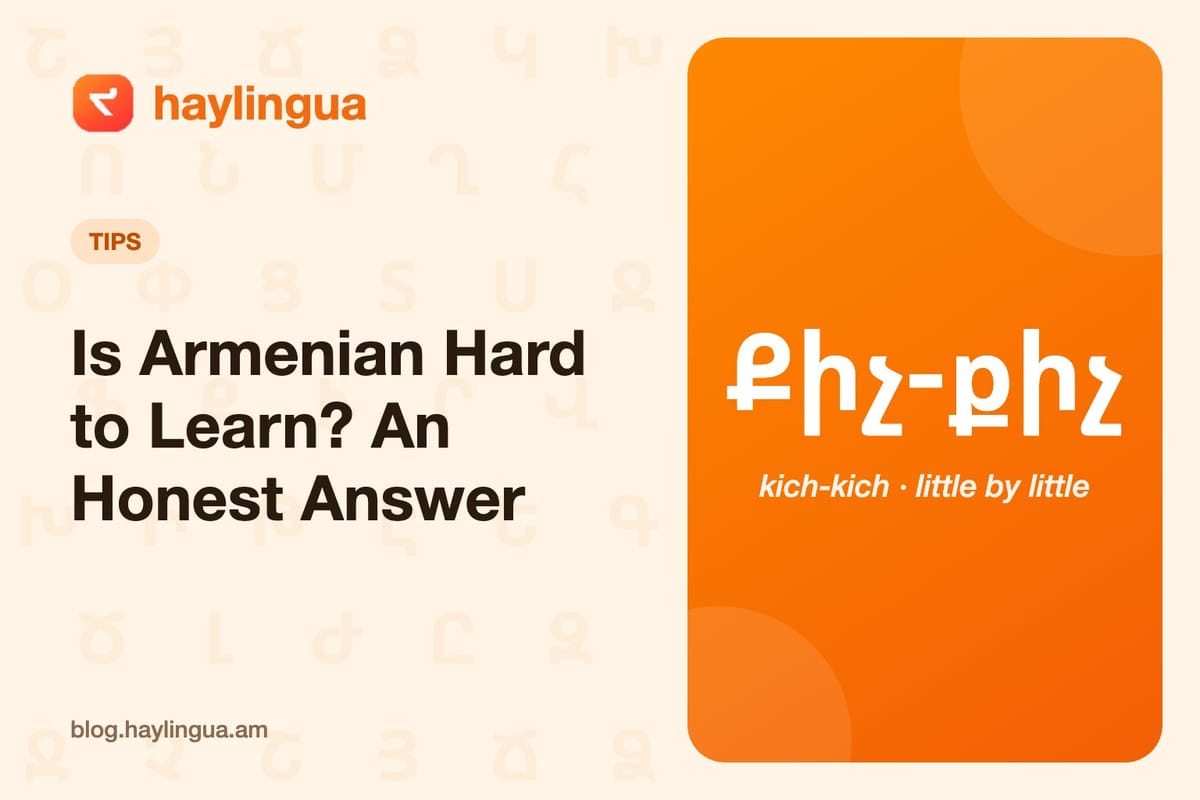
Whatever your starting point, the approach that works is the same: learn the alphabet properly, study a little every day, and speak from early on. As Armenians say, քիչ-քիչ (kich-kich) – little by little.
So is Armenian hard to learn? It asks for patience in the first few weeks, then rewards you steadily. And after a while you may find yourself agreeing with the sentence Հայերենը դժվար չէ (hayerenə dzhvar che) – Armenian isn't hard.
If you would like a clear, step-by-step way through the tricky parts, Haylingua teaches Eastern Armenian from the alphabet up to C1, one short lesson at a time.