Eastern vs Western Armenian: What's the Difference?
Eastern vs Western Armenian explained in plain terms: where the split came from, who speaks which, how pronunciation, spelling and grammar differ, and which one to learn first.

Anyone who starts learning Armenian soon finds out that there are two standard forms of the language. The question of Eastern vs Western Armenian comes up in almost every diaspora family and in most first lessons. Both are Armenian, both use the same alphabet, and speakers of one can usually follow the other with a bit of effort. But the differences are real. They affect how you pronounce words, how you spell them and which books you pick up.
Here is a plain overview of how the two differ, who speaks which, and how to decide where to start.
Where the split comes from
For centuries Armenians lived divided between empires. In the east they lived under Persian and later Russian rule, and in the west under the Ottoman Empire. In the 19th century two literary standards took shape: Eastern Armenian, based on the speech of Yerevan and the Armenian community of Tbilisi, and Western Armenian, based on the speech of Constantinople (Istanbul).
After 1915, most Western Armenian speakers who survived the genocide were scattered across the Middle East, Europe and the Americas. Eastern Armenian became the official language of Soviet Armenia, and today it is the official language of the Republic of Armenia.
Who speaks which
- Eastern Armenian is spoken in Armenia, by Armenians in Russia, Georgia and other former Soviet countries, and by the Armenian community in Iran.
- Western Armenian is spoken mainly in the diaspora: Lebanon, Syria, Istanbul, France, the United States, Canada, Argentina and elsewhere.
So if your grandparents came from Beirut or Aleppo, your family Armenian is probably Western. If they came from Yerevan or Tehran, it is Eastern. Iranian Armenians are an interesting case: they speak an Eastern variety but traditionally write in the classical spelling that Western Armenians use.
UNESCO lists Western Armenian as an endangered language. It has no country of its own, and fewer young people grow up speaking it at home.
Pronunciation: the biggest difference
The first thing most people notice when comparing Eastern vs Western Armenian is a handful of consonants. Eastern Armenian keeps three sounds apart in sets like b, p and an aspirated p. Western Armenian has merged some of these, and in several pairs the sounds are swapped compared with Eastern.
Names show it most clearly:
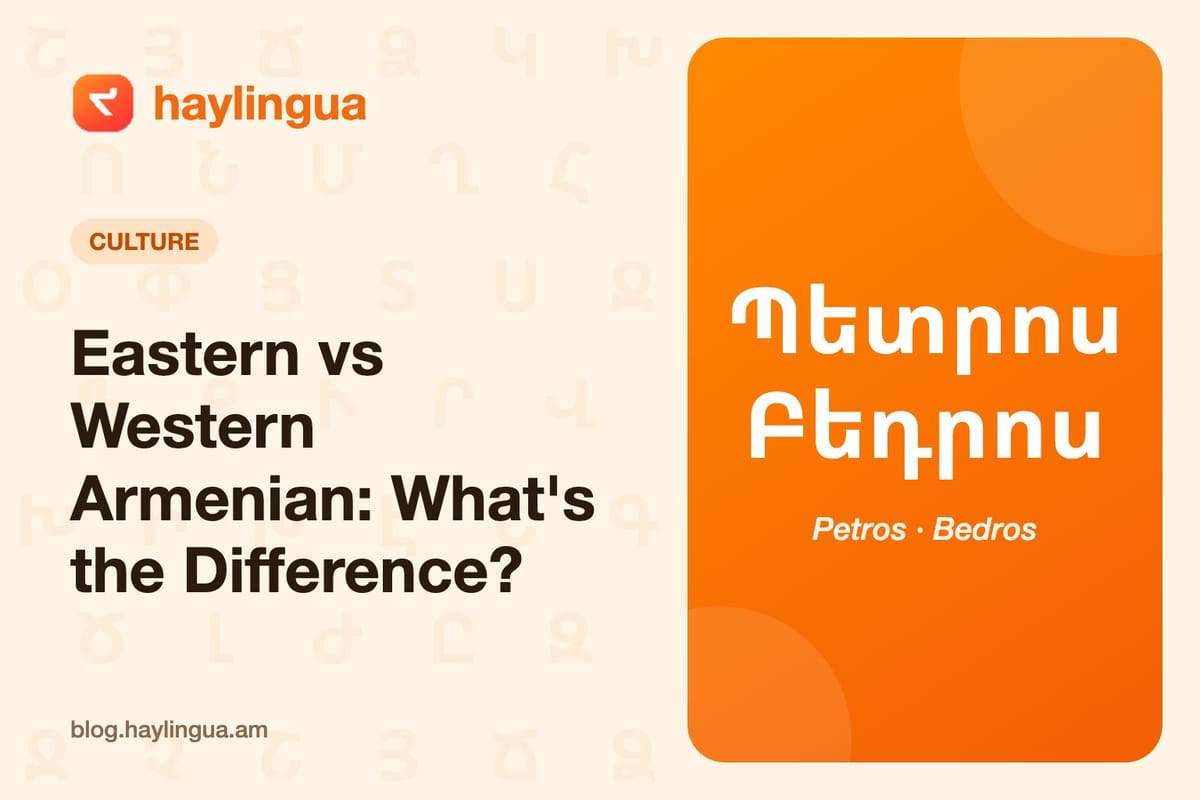
- Պետրոս – Petros in Eastern, Bedros in Western
- Տիգրան – Tigran in Eastern, Dikran in Western
- Գրիգոր – Grigor in Eastern, Krikor in Western
The same shift runs through everyday words. Ջուր (water) sounds like jur in Eastern and chur in Western. Once you know the pattern it stops being confusing, and after a while you start switching between the two in your head without thinking about it.
Spelling: classical vs reformed
Armenia uses a reformed spelling introduced in Soviet Armenia in the 1920s, with some later changes. Western Armenians, and Armenians in Iran, kept the older classical spelling, sometimes called Mashtots orthography after Mesrop Mashtots, who created the alphabet.
The letters are the same, but some words are written differently:
- Number is թիվ in reformed spelling and թիւ in classical spelling. Both are read tiv.
- The name Hakob is written Հակոբ in reformed spelling and Յակոբ in classical spelling, where it is pronounced Hagop.
- The surname ending is -յան in reformed spelling and -եան in classical spelling, which is part of the reason you see both Petrosyan and Petrosian in Latin letters.
- Ինչպե՞ս ես (inchpes es) – how are you, is written Ինչպէ՞ս ես in classical spelling, and Western speakers say it closer to inchbes es.
Grammar and vocabulary
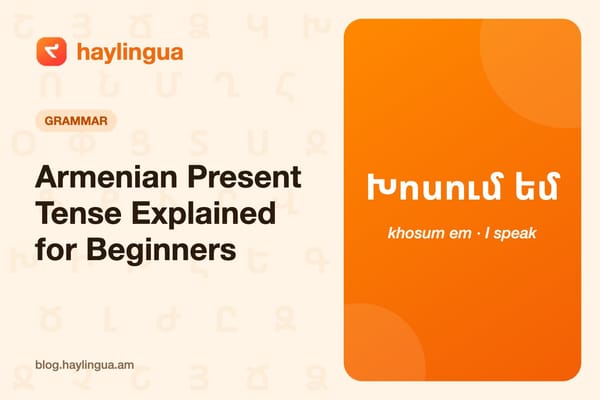
The grammar of the two standards is close, but a few forms differ in ways you notice straight away. The present tense is the classic example. Eastern builds it from a verb form ending in -ում plus the verb "to be", while Western puts a small particle in front of the verb:
- Eastern: Սիրում եմ (sirum em) – I love
- Western: Կը սիրեմ (ge sirem) – I love
Vocabulary is mostly shared, but everyday speech has drifted apart. Casual Eastern Armenian in Armenia has picked up a lot of Russian words, while Western Armenian absorbed words from Turkish, Arabic and French. Tomatoes are a well-known example. People in Yerevan often say պոմիդոր (pomidor), from Russian, while the standard word in both is լոլիկ (lolik, or lolig in Western pronunciation).
Can Eastern and Western speakers understand each other?
Mostly, yes. A Western Armenian from Beirut and an Eastern Armenian from Yerevan can have a proper conversation, especially once they get used to each other's accent. Learners usually find that after a few months with one standard, the other becomes much easier to follow.
Which one should you learn?
The honest answer depends on who you want to talk to.
- If you live in Armenia, plan to study or work there, or want to follow Armenian news and life in the country, learn Eastern.
- If your family speaks Western Armenian and your main goal is talking with grandparents or your community in Beirut or Paris, Western makes sense.
- If you have no strong family link and simply want to learn Armenian, Eastern is the practical choice. It has far more speakers, more learning materials and a whole country where you can practise every day.
Many diaspora learners worry that learning Eastern will cut them off from their family's Western Armenian. In practice that rarely happens. The alphabet, most of the vocabulary and the core grammar are shared, so what you learn carries over. At worst your relatives will tease you for sounding like a Հայաստանցի (hayastantsi) – someone from Armenia.
At Haylingua we teach Eastern Armenian, from the alphabet up to C1, with lessons built for diaspora learners and people living in Armenia. Western Armenian is on our roadmap too, so if that is the one your family speaks, keep an eye out for it.