Why Learning Armenian Is the Key to Unlocking a 3,000-Year-Old Culture


Learning a new language is always an investment — but learning Armenian is something different entirely. It's a doorway into one of the world's oldest living civilizations, a culture that has survived empires, diaspora, and centuries of transformation while keeping its language, traditions, and identity fiercely intact.
Whether you're a heritage learner trying to reconnect with your roots, or a polyglot drawn to one of the most linguistically unique languages on Earth, understanding the deep bond between Armenian language and culture is both the why and the how of learning it effectively.
What Makes the Armenian Language Unique?
Before diving into culture, it's worth understanding what sets Armenian apart linguistically.
- Its own branch of Indo-European. Armenian is the sole member of its branch — not a dialect of Persian, Greek, or any other family. It's been evolving independently for over 3,000 years.
- A custom-built alphabet. In 405 AD, the scholar Mesrop Mashtots created the Armenian script specifically for the language. All 38 letters (now 39) were designed to capture sounds no other alphabet could represent.
- Two standardized variants. Eastern Armenian is spoken in Armenia and Iran; Western Armenian is the form preserved by diaspora communities across Los Angeles, Beirut, Paris, and beyond. Both are mutually intelligible but noticeably distinct.
Key SEO terms: learn Armenian online, Armenian alphabet, Eastern vs Western Armenian, Armenian language course
5 Ways Armenian Culture Is Encoded in the Language
1. The Alphabet Is a Cultural Monument
When Mesrop Mashtots designed the Armenian script, his goal wasn't just linguistic — it was cultural preservation. The first sentence ever written in Armenian was a line from the Bible: "To know wisdom and instruction." That's not a coincidence. The alphabet was created to translate religious texts and protect Armenian identity from assimilation by Persian and Greek-speaking powers.
Today, the letter Ա (A) is a national symbol. Learning the Armenian alphabet isn't just a language exercise — it's an act of cultural participation.
2. Oral Tradition Lives Inside Everyday Phrases
Armenian is rich with idioms that reference its history directly. Common expressions reference bread (հաց, hats) as sacred, reflect the importance of family hierarchies, and encode a distinctly Armenian sense of resilience — what diaspora scholars sometimes call medzmama wisdom (grandmother wisdom).
When you learn Armenian vocabulary in cultural context, you're not just memorizing words. You're absorbing a worldview.
3. Armenian Cuisine Has Its Own Vocabulary
Food is one of the fastest entry points into any culture, and Armenian cuisine is no exception. But many of its most important dishes — khorovats (grilled meats), manti (Armenian dumplings), gata (sweet bread), lahmajoun — don't translate well, because they're cultural artifacts more than recipes. Learning their Armenian names, and the traditions around them, gives them their full meaning.
4. Music and Poetry Are Inseparable from the Language
The duduk, Armenia's ancient double-reed instrument, is UNESCO-listed. The poetry of Sayat-Nova, Hovhannes Shiraz, and Paruyr Sevak shaped the modern language as much as any grammar textbook. Armenian folk songs (erger) carry specific grammatical structures — repetition, vocatives, diminutives — that mirror how the language itself expresses emotion.
Many Haylingua learners report that exposure to Armenian music accelerated their listening comprehension far faster than textbook drills alone.
5. The Diaspora Kept the Language Alive
After the Armenian Genocide of 1915, over a million Armenians were scattered across the globe. The communities that formed in Lebanon, France, the United States, and Argentina didn't just preserve the language — they evolved it. Western Armenian developed distinct vocabulary, phonology, and even script conventions that now differ meaningfully from Eastern Armenian.
For diaspora learners, this is deeply personal: choosing to learn Armenian is often an act of reconnection with a language their grandparents may have stopped passing down out of grief or necessity.
Why Language and Culture Must Be Learned Together
Most language apps treat Armenian (if they carry it at all) like any other language: vocabulary decks, grammar tables, audio drills. But Armenian doesn't work that way in practice.
Context is everything. The word հոգի (hogi) means "soul," but it appears in expressions about weather, food, and farewells. The word կյանք (kyank) means "life," but its connotations in proverbs, songs, and everyday speech carry layers no dictionary captures.
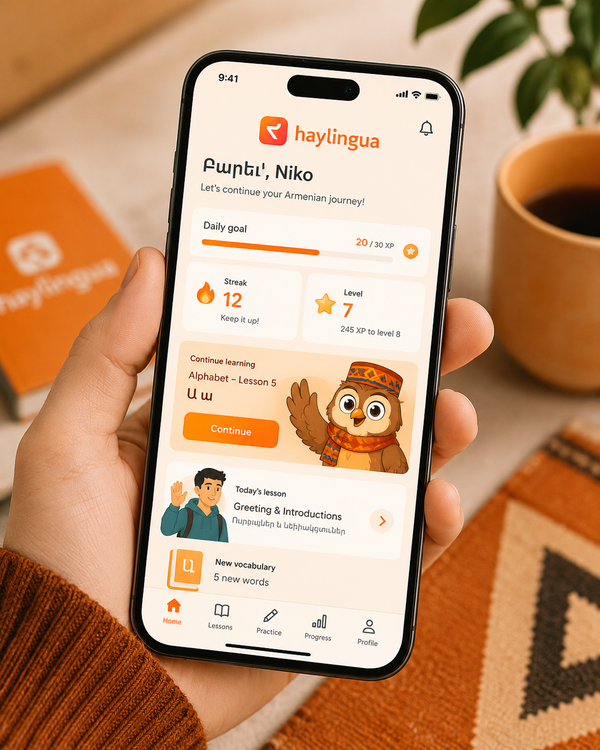
This is the core philosophy behind Haylingua: Armenian language learning that's built around culture, not despite it. Lessons are structured around real cultural moments — holidays, family conversations, historical context — so that vocabulary and grammar land in your memory attached to meaning, not floating in isolation.
Who Should Learn Armenian in 2026?
Heritage Learners and the Armenian Diaspora
If you have Armenian ancestry, the language is waiting for you. Millions of diaspora Armenians grew up hearing fragments — a grandmother's prayer, a kitchen expression, a lullaby — but never gained full fluency. Learning Armenian as an adult heritage speaker is a deeply rewarding process because so much is already stored in your memory; you're not starting from zero.
Polyglots and Language Enthusiasts
For learners who collect languages, Armenian is a genuinely rare challenge: a unique alphabet, an unusual phonological system (including sounds like ծ, ձ, ձ), and a grammar with no grammatical gender but a complex case system. If you want a language that will genuinely expand your linguistic range, Armenian delivers.
Travelers and Culture Seekers
Armenia's tourism has grown significantly in recent years. Yerevan, Lake Sevan, the monasteries of Geghard and Tatev, and the ancient city of Ani (in modern Turkey) draw visitors who want more than scenic photos. Even basic Armenian dramatically changes how locals receive you — and how much of the culture you actually access.
How to Start Learning Armenian: Practical Next Steps
- Start with the alphabet. It looks intimidating; it takes about 2–3 weeks of consistent practice to read fluently. Do this first — everything else depends on it.
- Decide: Eastern or Western Armenian? If you're connected to diaspora communities in the US, France, or Lebanon, Western Armenian is likely more meaningful. If you're interested in Armenia itself or planning to travel, Eastern Armenian is standard.
- Learn vocabulary in context. Don't drill isolated words. Learn phrases, idioms, and culturally grounded sentences from the start.
- Listen early and often. Armenian music, podcasts, and YouTube channels expose you to real speech patterns that textbooks can't replicate.
- Use a platform built for Armenian. Generic apps like Duolingo barely cover the language. Platforms built specifically for Armenian — like Haylingua — give you the cultural scaffolding that makes vocabulary stick.
Frequently Asked Questions About Learning Armenian
Is Armenian hard to learn for English speakers? Yes, but manageable. The Foreign Service Institute classifies Armenian as a Category III language (~1,100 hours to professional fluency). The alphabet and phonology are the steepest initial hurdles; grammar becomes intuitive with exposure.
What's the difference between Eastern and Western Armenian? Eastern Armenian is the official language of the Republic of Armenia. Western Armenian is the dialect spoken by most diaspora communities and is considered endangered by UNESCO. They share the same alphabet and core grammar but differ in pronunciation, some vocabulary, and certain grammatical conventions.
Can I learn Armenian online? Absolutely. Online learning is now the primary path for most Armenian learners outside Armenia, especially diaspora learners. Haylingua is built specifically for online, self-paced, culturally grounded Armenian learning.
Why is Armenian culture important to understand before learning the language? Because Armenian is not a neutral communication tool — it's a carrier of history, trauma, resilience, and identity. Understanding this context makes vocabulary meaningful, accelerates retention, and turns language learning into something genuinely enriching rather than rote memorization.
Start Your Armenian Language Journey with Haylingua
Haylingua was built for exactly this kind of learner: someone who wants to understand Armenian, not just speak it. Our lessons embed cultural context into every unit, covering the alphabet, Eastern and Western Armenian, conversational phrases, cultural traditions, and the history that makes the language what it is today.
Ready to begin? Start learning Armenian on Haylingua →